)
How a Centricity AR2000A Indexes a High Inertia Horizontal Assembly Machine
The Challenge: Fast Indexing Across a Wide Product Range Arnold Machine was engineering a horizontal indexing machine for an automated…
Read More
Arnold Machine was engineering an automated ID and OD coating system for conduit ranging from 3/4-inch through 6-inch trade sizes. The process had to handle products up to 10 feet long and advance one part through the system every 0.8 seconds. Each index moved the conveyor exactly 12 inches, making rapid, repeatable motion essential to maintaining the required coating cycle time. 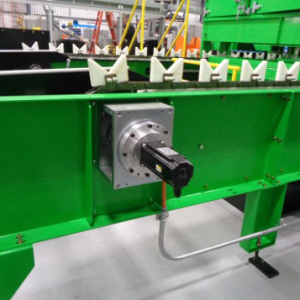
The drag chain assembly weighed as much as 2,500 pounds, including the C2120 steel chain, SK-2 chain attachments, and custom V-block fixtures. The drive also had to accommodate the system’s heaviest product: a 10-foot length of trade size 6 conduit. Combining long workpieces, substantial moving mass, and a sub-one-second index created a demanding application in which startup torque, acceleration, and controlled positioning all mattered.
Arnold Machine calculated a theoretical starting breakaway torque of 1,067 ft-lbs. The selected drive needed to overcome that static condition from zero speed, accelerate the conveyor quickly enough to meet the process window, and settle accurately at the end of each move without applying unnecessary shock to the chain, fixtures, or product.
Arnold Machine modeled the conveyor in Rockwell Automation Motion Analyzer. The engineering model used a 5,500-pound load, a horizontal inclination of zero degrees, and a coefficient of friction of 0.25 between the drag chain and its nylon chain guides. Modeling the complete load and resistance allowed the team to evaluate velocity, acceleration, torque, and motor performance across the entire index rather than sizing the drive from a running-torque estimate alone.
Within Motion Analyzer, the Centricity unit was represented as a 101:1 transmission. This gave the engineering team a practical way to test the selected Allen-Bradley servo motor against the real motion requirement and confirm that the system could deliver the required output torque at startup while remaining within the motor’s operating-speed range.
The aggressive theoretical motion profile established the upper performance boundary for the 12-inch move. From there, the controls team could shape the commanded acceleration and deceleration around the actual coating process, balancing cycle time with smooth mechanical operation.
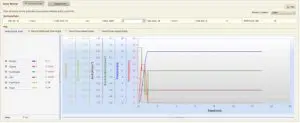
Figure 2 – Rockwell Automation Motion Analyzer theoretical profile used during conveyor drive sizing.
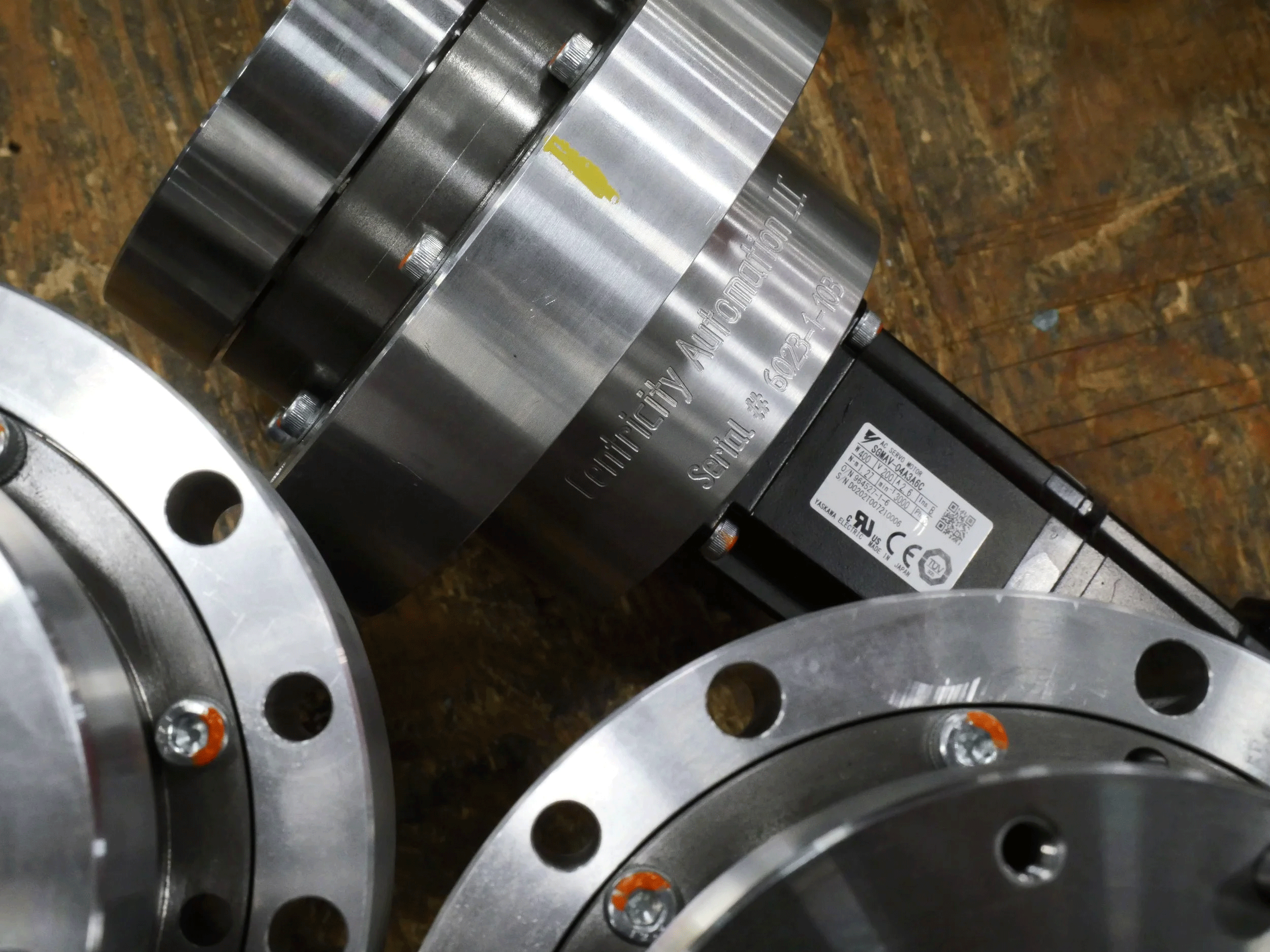
Arnold Machine paired a Centricity AR2000C servo index unit with an Allen-Bradley VPL-B1153F servo motor. The motor is rated for 4,250 rpm, while the application requires a maximum of approximately 1,930 rpm. This kept the operating point comfortably below the motor’s maximum speed while allowing the AR2000C’s 101:1 reduction to multiply torque at the conveyor drive shaft.
The motor’s continuous stall torque is 4.83 ft-lbs, producing approximately 488 ft-lbs through the Centricity unit. Its peak stall torque is 15 ft-lbs, translating to approximately 1,515 ft-lbs at the output. Compared with the 1,067 ft-lbs theoretical breakaway requirement, the selected combination provides greater than 1.5 times the required torque output from zero speed.
That peak reserve was especially important for this application. A drag chain conveyor must reliably start with its full load, overcome static friction at the guides, and absorb normal variation in product weight and mechanical resistance. At the same time, the servo platform gives the controls team authority over the complete motion profile instead of relying on fixed-speed mechanical transmission components.
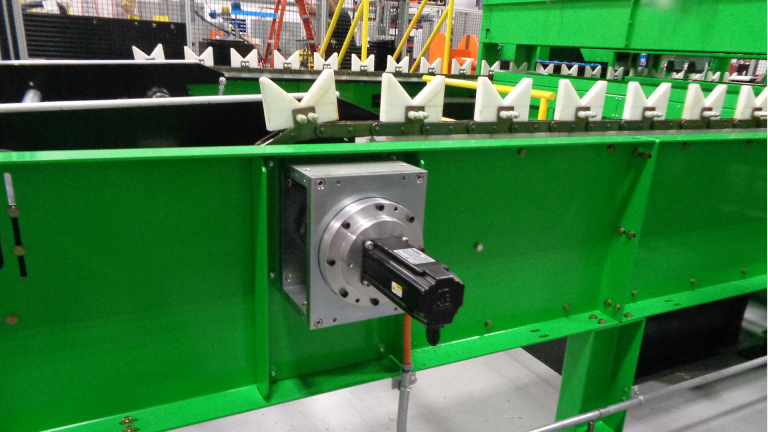
The 10-foot product length created a second challenge beyond motion control: a fully assembled conveyor would have been an oversize shipping load. Arnold Machine used the Centricity unit as the foundation for a drive arrangement that allowed the conveyor to be divided into two transportable sections.
The team designed a special Centricity mount incorporating a shaft-locking hub and an external piloted bearing connected to the drive shaft. Rigid shaft couplers linked the main drive shaft on each side of the conveyor. This configuration allowed the two conveyor halves to ship separately and remain well under standard width constraints, then be mechanically reconnected during installation.
The approach addressed logistics without giving up a common drive line or the precision of a servo-controlled index. It also illustrates an important advantage of applying a compact, configurable index unit: the drive can become part of the machine’s mechanical architecture rather than forcing the conveyor layout to conform to a conventional gearmotor package.
The completed motion strategy advances one conduit every 0.8 seconds over a 12-inch index. That timing supports the required ID and OD coating sequence across the full product range, from 3/4-inch conduit through the 10-foot-long trade size 6 product used for the maximum-load analysis.
Because the drive is servo controlled, the move can be tuned around the process instead of simply switched on and off. Acceleration, peak speed, deceleration, and final position can be coordinated to meet throughput while limiting abrupt load changes in the chain and fixtures. This is particularly valuable when a single system must handle a wide range of conduit diameters and corresponding part weights.
The Centricity AR2000C-driven solution gives Arnold Machine the calculated startup capacity, greater than 1.5:1 peak torque margin, precise 12-inch positioning, and the speed required for a 0.8-second index. Pairing the unit with the specified Allen-Bradley servo also kept the conveyor aligned with the machine’s Rockwell Automation controls architecture.
Just as important, the custom drive-shaft arrangement allowed the long conveyor to be split for shipment without compromising the common mechanical drive. For machine builders, the application demonstrates how a servo indexing unit can solve more than a torque problem. When load modeling, motion control, machine layout, and installation logistics are engineered together, the drive system can support both production performance and practical equipment delivery.
Please provide as much information as possible to ensure an accurate quote or product recommendation. Your information will not be sold or shared.
Find the right indexer