)
How a Centricity AR2000A Indexes a High Inertia Horizontal Assembly Machine
The Challenge: Fast Indexing Across a Wide Product Range Arnold Machine was engineering a horizontal indexing machine for an automated…
Read More
Arnold Machine was engineering a horizontal indexing machine for an automated rod assembly process. The equipment had to handle four rod diameters: 3/8 inch, 1/2 inch, 5/8 inch, and 3/4 inch. Product lengths ranged from 10 to 50 inches, so the indexing mechanism needed to accommodate significant differences in part size while preserving the production rate across the complete range.
The machine used rotating wheels to advance each rod through the process. Every production cycle required a 20-degree index in 0.5 seconds, followed by the assembly operation, for an overall machine cycle time of 1.7 seconds. Any hesitation during startup, excess settling time, or inconsistent final position would directly reduce the time available for the work performed at each station.
The drive also had to manage substantial rotational inertia. Arnold Machine calculated a maximum wheel assembly inertia of 12,354 lb-in2, including the shaft, keys, hubs, wheels, coupler, and the heaviest production part. This made the application less about moving a large linear load and more about accelerating, controlling, and stopping a high-inertia rotating assembly within a tightly defined motion window.
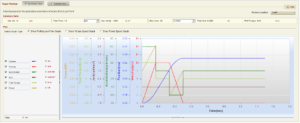
Arnold Machine used Rockwell Automation Motion Analyzer to model the application before finalizing the drive. The software represented the Centricity AR2000A as a 103:1 transmission, allowing the engineering team to evaluate the motor, reduction, load inertia, speed, acceleration, torque, and power as one system.
The theoretical motion profile established the most aggressive operating boundary. It modeled the 20-degree move, equivalent to approximately 0.0556 revolution, and showed how position, velocity, acceleration, total torque, and power changed throughout the move. The production requirement called for a 0.5-second index, while the complete modeled review window also showed the load at rest after the commanded motion.
This system-level analysis was important because breakaway torque alone does not define a successful indexing application. The motor and index unit must also accelerate the reflected inertia quickly, remain within speed limits, decelerate the mechanism in a controlled manner, and reach the commanded position early enough for the next assembly operation to begin.
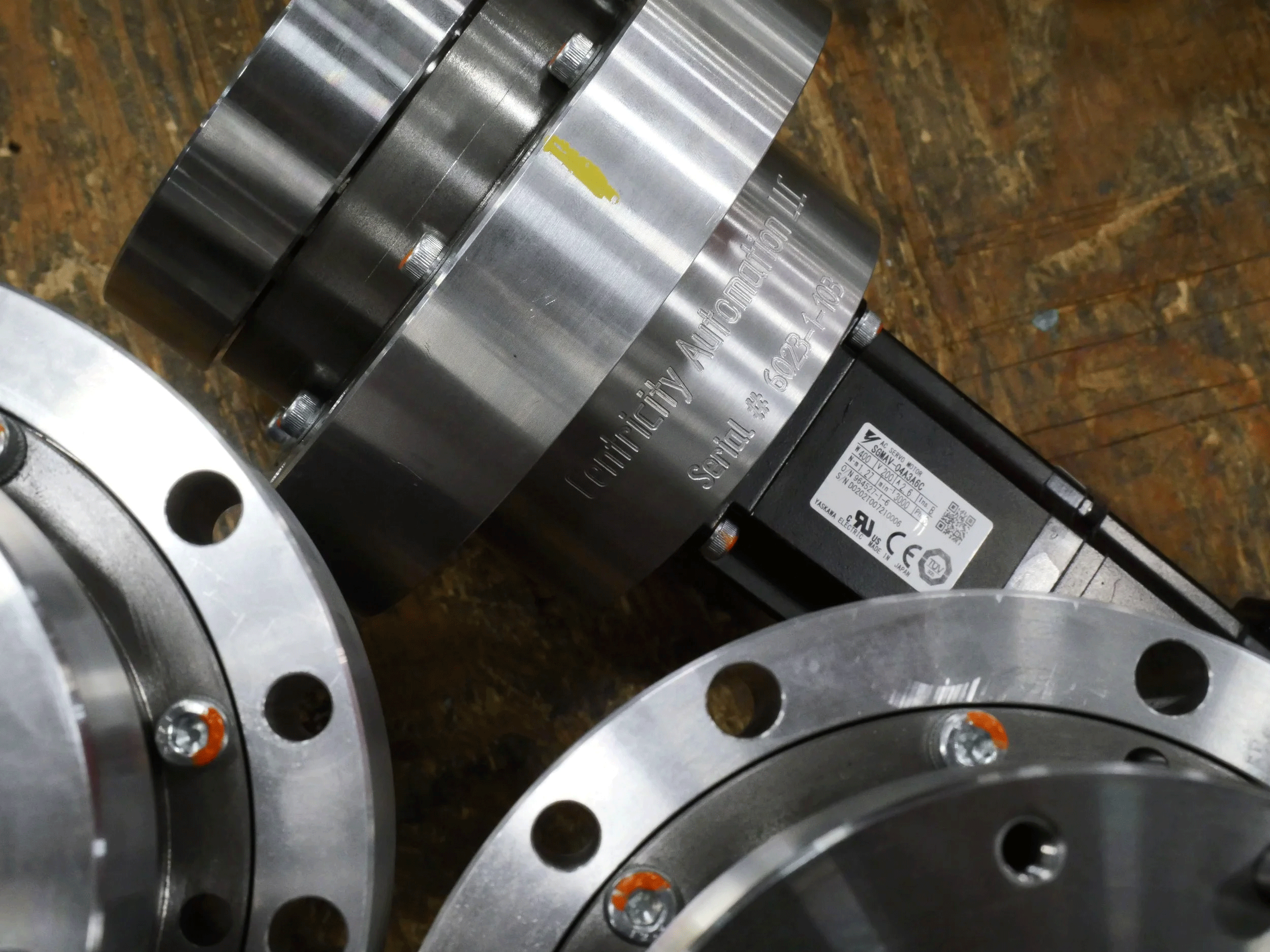
Arnold Machine selected a Centricity AR2000A servo index unit and paired it with an Allen-Bradley VPL-B0753E-PJ14AA servo motor. The motor is rated for 4,500 rpm, while the application requires a maximum motor speed of approximately 1,030 rpm. The resulting operating point stays well below the motor’s rated speed while the AR2000A’s 103:1 reduction converts the motor’s output into the torque required at the indexing wheels.
The theoretical starting breakaway requirement was 25 ft-lbs. The selected motor provides 1.68 ft-lbs of continuous stall torque, which becomes approximately 173 ft-lbs through the Centricity unit. That represents about 6.9 times the calculated breakaway requirement. Peak stall torque is 5.42 ft-lbs, producing approximately 558 ft-lbs at the output, or more than 22 times the theoretical breakaway torque.
That calculated reserve gives the system capacity to do more than initiate motion. It provides room to accelerate the full rotating assembly, manage variation across rod sizes and lengths, and tune the move without operating at the edge of the drive’s capability. The servo motor also keeps the motion profile programmable, allowing the controls team to coordinate acceleration, velocity, deceleration, and final position with the assembly sequence.
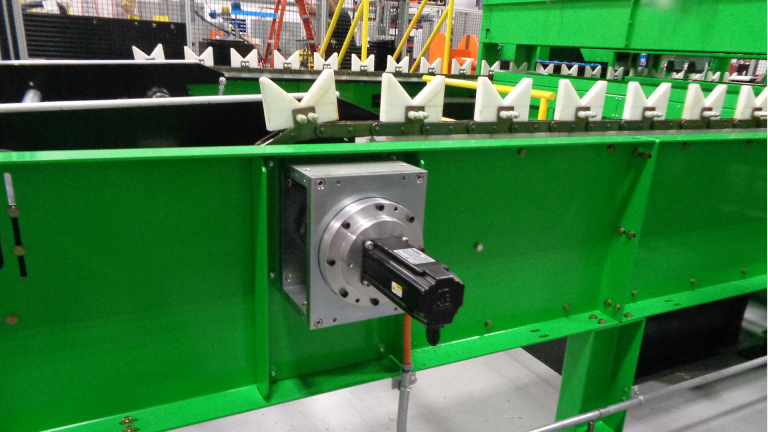
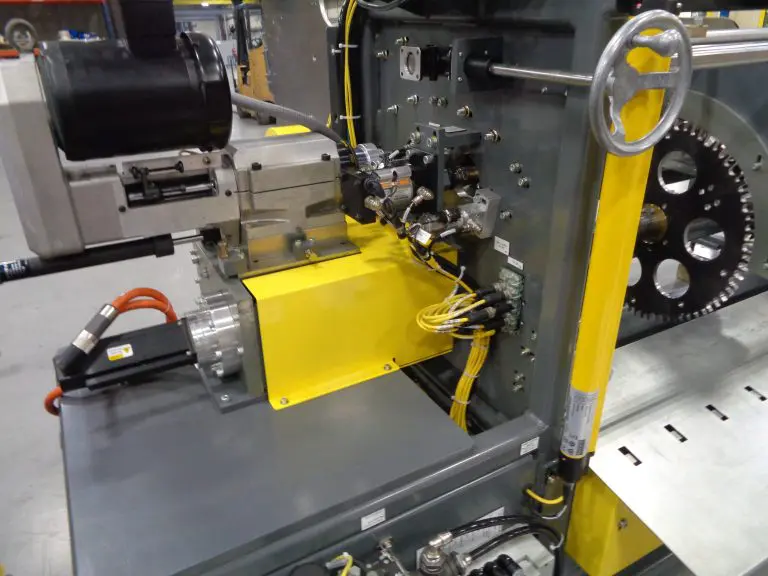
The AR2000A was mounted directly within the machine structure and coupled to the horizontal indexing shaft. This compact arrangement placed the servo motor and reduction close to the driven mechanism, reducing the need for a separate gearmotor, external transmission, or more elaborate drivetrain.
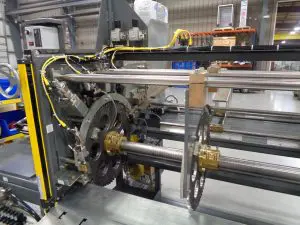
The photographs show the index unit installed beside the machine tooling and the horizontal wheel assembly used to transport the rods. The rotating components, shafting, couplings, and large indexing wheels explain why inertia was the controlling sizing factor even though the theoretical breakaway torque was comparatively modest.
For the machine builder, using an AR Series unit also preserved the preferred Allen-Bradley motion platform. The servo motor, drive, cables, and programming remained part of the Rockwell Automation controls architecture, while the Centricity unit supplied the mechanical reduction and load-carrying structure needed for the application.
The engineered motion profile allows the wheels to advance 20 degrees within the required 0.5-second index window. Completing that move predictably supports the overall 1.7-second machine cycle and protects the time allocated to the assembly operation at each station.
Because the move is servo-controlled, the system is not limited to a fixed mechanical index. Motion parameters can be tuned around the rotating load and the behavior of the rods, which is valuable when the same machine processes diameters from 3/8 inch through 3/4 inch and lengths from 10 through 50 inches. The result is a drive strategy built around the process rather than a process forced to accommodate a fixed-speed drive.
The Centricity AR2000A gave Arnold Machine a compact way to control a 12,354 lb-in2 rotating assembly while meeting a 20-degree, 0.5-second index requirement. The selected Allen-Bradley motor operates well below its rated maximum speed, and the calculated output provides substantial continuous and peak torque margin over the theoretical breakaway requirement.
For machine builders, the application demonstrates why servo indexer selection must consider inertia, motion time, and process timing together. By combining load modeling, high-ratio torque multiplication, a customer-preferred servo platform, and a programmable motion profile, Arnold Machine and Centricity created an indexing solution suited to a fast, flexible horizontal assembly process.
Please provide as much information as possible to ensure an accurate quote or product recommendation. Your information will not be sold or shared.
Find the right indexer